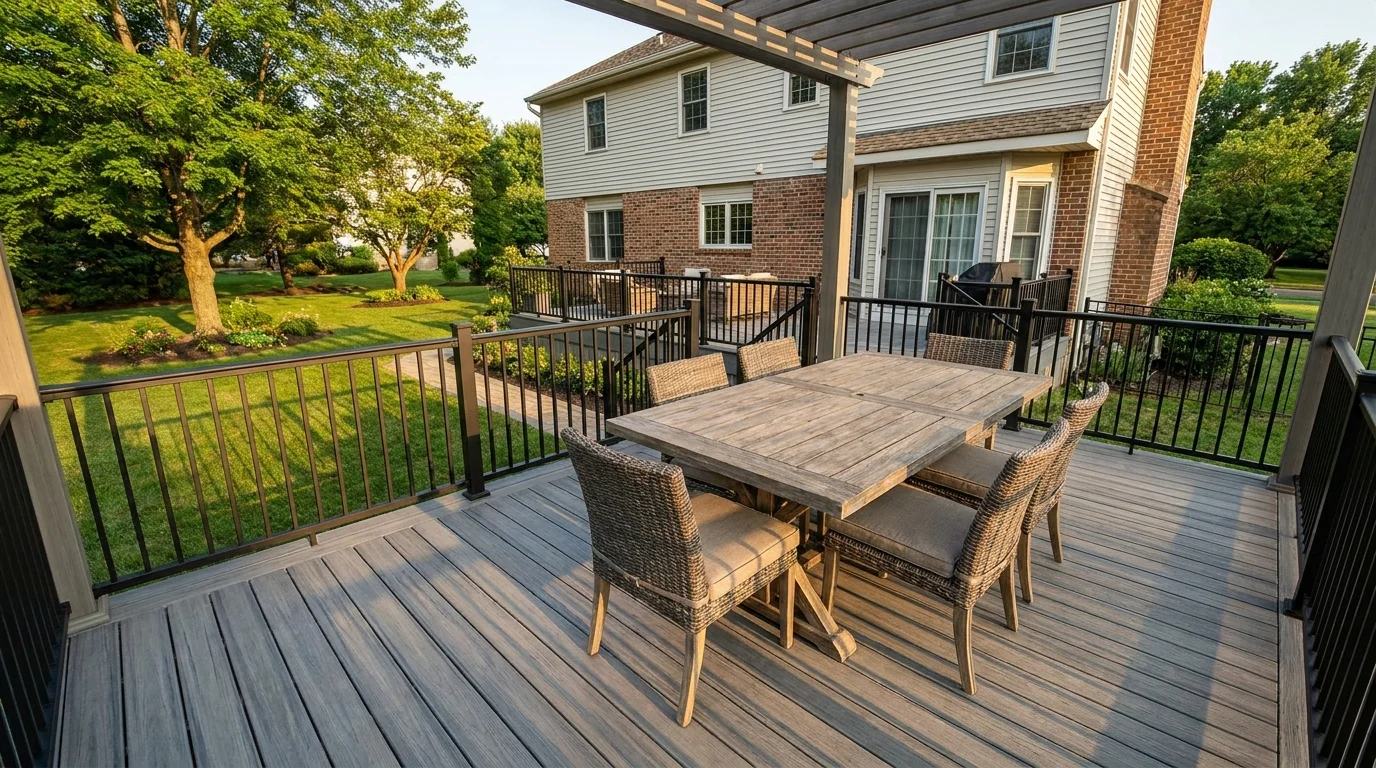
In 2026, homeowners in New Jersey can expect composite deck packages to start from about $16,000 for a 200 sq ft deck and approximately $24,000 for a 300 sq ft deck. These figures typically include high-quality decking such as Trex Enhance, Fiberon Regency railings, the necessary framing, and professional installation. While these provide a solid starting point for planning, the final cost can vary based on design complexity, additional features, and site-specific conditions across areas like Long Branch, Red Bank, or Asbury Park.
Investing in a composite deck offers a durable, low-maintenance outdoor living space that enhances your home's value and enjoyment for years to come. Understanding the components of these costs will help you make an informed decision for your Monmouth County property.
How Much Does a Composite Deck Cost in New Jersey in 2026?
The cost of a composite deck in New Jersey is influenced by its size, the specific materials chosen, and the complexity of the design. IAC Home Improvement provides comprehensive packages that simplify the process, offering clear pricing for popular deck sizes.
Typical Composite Deck Package Costs
Our composite deck packages are designed to provide a complete solution, encompassing the main components of a high-quality deck. These starting prices offer a transparent look at what you can expect for common deck dimensions.
| Approximate Deck Size | Starting Package Price (Approx.) | Key Inclusions |
|---|---|---|
| 200 sq ft | About $16,000 | Trex Enhance decking, Fiberon Regency railings, framing, installation |
| 300 sq ft | About $24,000 | Trex Enhance decking, Fiberon Regency railings, framing, installation |
| Custom Sizes | Quoted per project | Design consultation, personalized material selection, full installation |
What's Included in a Standard Composite Deck Package?
When you choose a standard composite deck package from IAC Home Improvement, you receive a robust foundation for your outdoor living space. Our packages are built around quality materials and expert craftsmanship to ensure longevity and aesthetic appeal.
- Decking Material: High-quality composite decking, such as Trex Enhance, known for its durability, low maintenance, and wide range of color options.
- Railing System: A complete railing system, typically Fiberon Regency, which combines strength with a clean, attractive design, ensuring safety and compliance with building codes.
- Structural Framing: All necessary pressure-treated lumber for the deck's substructure, including posts, beams, and joists, engineered for stability and longevity.
- Professional Installation: Full installation services by our experienced team, covering everything from site preparation and foundation work to the final decking and railing assembly.
It is important to note that certain custom features and enhancements are quoted separately to allow for complete personalization. These often include gates, privacy lattice, specialized lighting, custom pergolas, or built-in seating, which can significantly enhance the deck's functionality and ambiance.
A Cost Example: A 300 sq ft Deck in Monmouth County
Consider a homeowner in Middletown or Manalapan looking to add a new 300 sq ft composite deck. Based on our package pricing, a project of this size would typically start at about $24,000. This includes premium Trex Enhance decking, a Fiberon Regency railing system, all necessary framing, and professional installation.
This price provides a complete, ready-to-enjoy deck. Should the homeowner desire additional elements, such as integrated stair lighting for evening enjoyment or a custom gate for pet safety, these would be added to the base package cost. These additions are always discussed and itemized clearly during the quotation process. For homeowners exploring various decking options, including beautiful hardwood choices like cedar and IPE, we invite you to learn more about our hardwood decking services, which are priced upon request due to their custom nature.
Ready to explore options for your home in Long Branch, Red Bank, or anywhere in Monmouth County? Contact IAC Home Improvement today for a free on-site consultation and a personalized quote. You can call us at (848) 234-0283, text us a photo of your existing space, or request a free estimate online.
What Factors Influence the Final Price of Your Composite Deck?
While package pricing provides a great starting point, several variables can adjust the final cost of your composite deck project. Understanding these factors allows homeowners in New Jersey to better plan their budget and design choices.
Deck Size and Complexity
The overall dimensions and architectural intricacies of your deck significantly impact the final price. Larger decks naturally require more materials and labor, increasing the base cost.
- Footprint: A larger square footage directly correlates with higher material and labor costs.
- Multi-Level Designs: Decks with multiple levels, intricate angles, or curved sections demand more complex framing, additional support structures, and specialized cutting, all of which add to the labor and material expenses.
- Elevation: Elevated decks requiring taller posts, more extensive bracing, or additional steps to reach grade will be more expensive than ground-level platforms.
- Foundation Requirements: Depending on soil conditions and local building codes, more robust or specialized foundations (e.g., helical piles) may be necessary, especially in areas with challenging terrain, influencing the overall cost.
Material Choices and Features
The specific composite brand, decking line, and any added features play a crucial role in determining the total investment. Different manufacturers and product tiers offer varying levels of aesthetics, durability, and cost.
- Composite Brand and Series: While our packages feature Trex Enhance, other premium composite brands like Fiberon, Azek, or higher-tier Trex lines (e.g., Trex Transcend) come at different price points. These often offer enhanced aesthetics, scratch resistance, or fade protection.
- Railing Styles: Beyond standard composite railings, options like aluminum balusters, glass panels, or custom-designed railing systems can elevate the deck's look and cost.
- Additional Features: Custom elements such as integrated LED lighting, decorative gates, privacy lattice, built-in planters or benches, and elaborate stair designs will add to the project's complexity and material requirements.
- Underdecking Systems: Solutions designed to create dry space beneath an elevated deck, such as Trex RainEscape, involve additional materials and installation labor.
Site Preparation and Accessibility
The condition of your property and the ease with which materials and equipment can be brought to the construction site can also affect labor hours and overall project costs. Demolition, grading, and accessibility are key considerations.
- Demolition of Existing Structures: Removing an old deck, patio, or other structures requires additional labor and disposal fees.
- Site Grading and Drainage: If the proposed deck site requires significant excavation, leveling, or improvements to ensure proper drainage, these preparatory steps will add to the project cost.
- Accessibility: Projects in backyards with limited access, requiring materials to be carried long distances or through narrow passages, can increase labor time and thus the overall price.
- Permitting: While not a direct material or labor cost, permit fees are a necessary part of the project in most New Jersey municipalities like Eatontown or Holmdel, ensuring compliance with local building codes.
Composite vs. Wood Decking: Is the Investment Worth It?
When planning a new deck in New Jersey, homeowners often weigh the pros and cons of composite decking against traditional wood options. Both materials offer distinct advantages, particularly concerning upfront cost, long-term maintenance, and aesthetic appeal.
Initial Cost Comparison
Generally, composite decking has a higher upfront material cost compared to standard pressure-treated wood. However, this initial investment often needs to be considered alongside the long-term value.
Pressure-treated pine is typically the most budget-friendly option initially, while premium hardwoods like cedar and IPE (often priced on request due to their exotic nature) can rival or even exceed composite costs. While composite boards might cost more per linear foot, their consistent quality and reduced waste during installation can sometimes offset a portion of that difference. For those interested in traditional wood options, you can explore more about building an outdoor deck in NJ with various materials.
Long-Term Value and Maintenance
The true cost-effectiveness of composite decking often becomes apparent over its lifespan due to significantly reduced maintenance requirements. This is a major factor for many homeowners in Marlboro and Colts Neck.
Composite decks are engineered to resist fading, staining, scratching, and insect damage, often backed by warranties extending 25-30 years or more. They do not require sanding, staining, or sealing, saving homeowners considerable time and money on maintenance products and labor over the decades. In contrast, wood decks, particularly pressure-treated varieties, typically require annual or biennial cleaning, staining, and sealing to protect against weathering, rot, and insect infestation. This ongoing maintenance is crucial to extend the life of a wood deck, and neglecting it can lead to costly repairs or premature replacement. For guidance on maintaining wood decks, refer to our deck staining and sealing guide.
Environmental and Aesthetic Considerations
Beyond cost and maintenance, composite and wood decks offer different benefits concerning environmental impact and visual appeal.
Many composite decking products are made from recycled plastics and wood fibers, making them an environmentally conscious choice. They offer a consistent, uniform appearance with a wide array of colors and textures that mimic natural wood, without the natural imperfections. This consistency ensures a cohesive look that is easy to match or expand upon. Natural wood decks, on the other hand, provide an authentic, organic aesthetic that many homeowners find appealing. The unique grain patterns and natural variations of wood cannot be replicated, and they can be stained to achieve a variety of colors. However, wood is susceptible to weathering, fading, and splintering over time, which can alter its initial appearance.
Understanding the Composite Deck Installation Process
Installing a composite deck is a multi-stage process that requires careful planning, adherence to local regulations, and skilled craftsmanship. A professional contractor ensures that each phase is executed correctly for a safe, durable, and beautiful outcome.
Planning and Design Considerations
The initial planning and design phase is critical for ensuring your new deck perfectly meets your needs and complements your home's architecture. This stage involves more than just aesthetics; it's about functionality and safety.
During design, factors such as the deck's intended use (dining, entertaining, relaxation), desired size, shape, and integration with existing landscape features are carefully considered. Our designers work with you to optimize traffic flow, sunlight exposure, and privacy, creating a space that feels like a natural extension of your home. We also advise on material selections, from specific composite board colors and textures to railing styles, ensuring the final product aligns with your vision and budget.
Permitting and Regulations in NJ
Building a new deck in New Jersey, or significantly altering an existing one, almost always requires obtaining local building permits. This ensures that the structure meets safety standards and local zoning ordinances.
Our team at IAC Home Improvement is well-versed in the permitting requirements for various municipalities across Monmouth County, including Freehold, Holmdel, and Manalapan. We assist homeowners through this process, ensuring all plans comply with the New Jersey Uniform Construction Code and any specific local regulations. This typically involves submitting detailed drawings and specifications for review by the local building department. Obtaining the necessary permits before construction begins is a crucial step to avoid potential fines or costly modifications later.
The Installation Stages
Once permits are secured and the design is finalized, the physical installation of your composite deck proceeds through several distinct stages, each performed with precision and attention to detail.
- Site Preparation: This involves clearing the area, removing any existing structures, and grading the land to ensure proper drainage and a stable base for the foundation.
- Foundation Installation: Concrete footings are dug and poured, or helical piles are installed, providing the essential support for the deck's structure. These must be set below the frost line in New Jersey to prevent shifting.
- Framing: The deck's substructure, consisting of pressure-treated lumber beams and joists, is constructed. This framework forms the skeleton of the deck, ensuring its strength and stability.
- Composite Decking Installation: The composite boards are carefully installed, typically using hidden fastening systems for a clean, seamless appearance. Boards are cut to size and laid out according to the design plan.
- Railing and Stair Construction: The railing system, including posts, balusters, and handrails, is securely installed, along with any stairs, ensuring they meet safety codes and are aesthetically pleasing.
- Final Touches and Cleanup: Any custom features like lighting or gates are installed, and the entire site is thoroughly cleaned, leaving you with a beautiful, ready-to-enjoy outdoor living space.
Most standard composite deck installations typically take anywhere from one to two weeks, depending on the size and complexity of the project, though custom designs may require more time.
How to Get an Accurate Composite Deck Quote in New Jersey
Securing an accurate quote for your composite deck project is essential for effective budget planning and ensuring your vision comes to life. A thorough evaluation by a reputable contractor is the best way to receive a precise estimate.
Why an On-Site Visit is Crucial
A free, on-site consultation is the most critical step in obtaining an accurate and comprehensive quote for your composite deck. Generic estimates based solely on square footage often miss vital details.
During an on-site visit, our experts at IAC Home Improvement can accurately measure the proposed deck area, assess the terrain for any grading or drainage issues, and evaluate accessibility for materials and equipment. We can also identify potential challenges, such as existing utility lines or specific soil conditions, that might impact the project's scope or cost. This personalized assessment ensures that all unique aspects of your property in towns like Eatontown, Red Bank, or Freehold are considered, leading to a much more precise and reliable quote than a remote estimate.
What to Discuss During Your Consultation
To make the most of your consultation, come prepared to discuss your ideas, preferences, and any questions you may have. This open dialogue helps us tailor the perfect solution for you.
Be ready to articulate your vision for the deck, including its primary use, desired size, specific features (like built-in seating, lighting, or pergolas), and any material preferences (e.g., specific Trex or Fiberon lines). Discuss your budget expectations, desired timeline, and any concerns you might have about the installation process or long-term maintenance. This is also an excellent opportunity to ask about our experience, licensing (NJ License #13VH13143000 and PA License #PA188007), and review our portfolio. Remember that IAC Home Improvement is a full-service home improvement company, meaning we can seamlessly integrate your new deck with other home projects, such as flooring, kitchen and bathroom remodeling, painting, carpentry, basements, masonry, concrete, and pavers, offering a single trusted contractor for your whole home.
Choosing the Right Contractor
Selecting the right contractor is paramount to the success and longevity of your composite deck project. Look for experienced professionals who prioritize quality and transparent communication.
Always choose a licensed and insured contractor with a proven track record in composite deck installations. Check their reviews and testimonials; IAC Home Improvement, in business since 2015, is proud of our 5.0 Google rating with over 100 positive reviews. A reputable contractor will provide a clear, detailed quote that outlines the total project cost without hidden fees, rather than itemizing labor and materials separately. They should also be knowledgeable about local building codes and permitting requirements, guiding you through every step of the process with professionalism and expertise.
Frequently Asked Questions About Composite Deck Costs
How long do composite decks typically last?
Composite decks are renowned for their exceptional durability and longevity. Most high-quality composite decking products, such as Trex and Fiberon, are designed to last 25 to 30 years or even longer. Many manufacturers offer extensive warranties, sometimes up to 25 years, covering material defects, fading, and staining, which underscores their long-term value and robust performance in various climates.
Do composite decks require any maintenance?
While composite decks are often referred to as "low-maintenance," they are not entirely maintenance-free. They do not require sanding, staining, or sealing like wood decks. Typically, composite decks only need occasional cleaning with soap and water or a pressure washer on a low setting to remove dirt, pollen, and mildew. This simple cleaning routine helps preserve their appearance and ensures they remain beautiful for decades.
Are there different grades or qualities of composite decking?
Yes, there are various grades and qualities of composite decking available from different manufacturers and within a single brand's product lines. These differences often relate to core material composition, capstock technology (which provides surface durability and aesthetics), color options, grain patterns, and warranty coverage. For example, Trex offers lines like Enhance, Select, and Transcend, each with distinct features, price points, and levels of scratch and fade resistance, allowing homeowners to choose based on their budget and desired performance.
Can I add features like lighting or custom railings later?
While it is technically possible to add features like integrated lighting or custom railings to a composite deck after its initial construction, it is generally more cost-effective and structurally sound to include them in the original design and build. Incorporating these elements from the outset allows for seamless integration, proper wiring concealment, and optimized structural support, often preventing the need for costly retrofitting or potential compromises to the deck's integrity or aesthetic.
Authoritative resource: North American Deck and Railing Association.