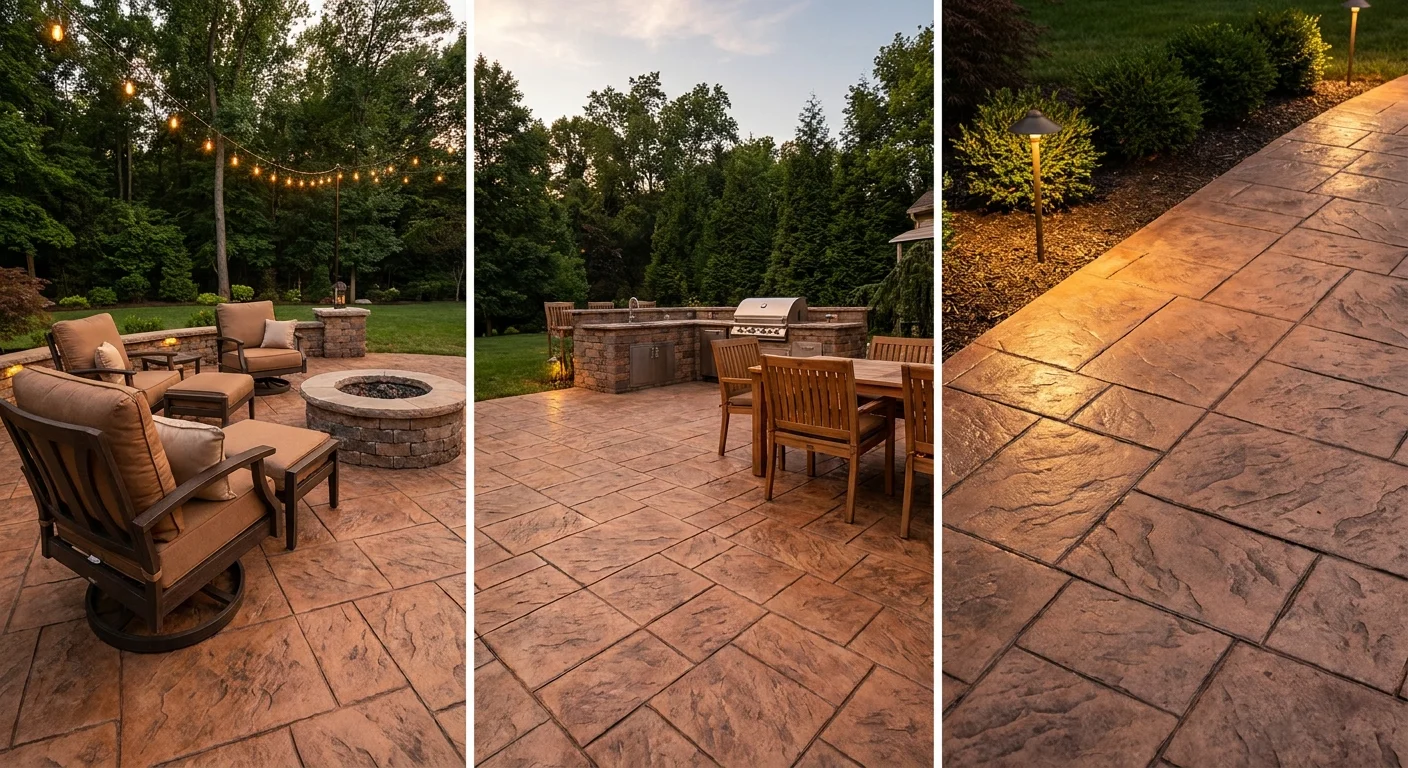
Stamped concrete offers an exceptional blend of aesthetic appeal and lasting durability, making it a premier choice for patios, walkways, and other outdoor surfaces across New Jersey, New York, and Pennsylvania. It involves imprinting wet concrete with patterns and textures to mimic natural materials like stone, brick, or wood, providing a highly customizable and cost-effective alternative to traditional paving options.
What is Stamped Concrete? A Versatile Choice for NJ Homes
The Art of Concrete Stamping: How It Works
Stamped concrete is a specialized process that transforms ordinary concrete into an attractive, textured surface resembling more expensive materials. The technique begins with pouring a concrete slab, typically a mix designed for exterior use with a minimum compressive strength of 4000 PSI to withstand freeze-thaw cycles common in Holmdel and throughout the Northeast. While the concrete is still wet and pliable, a release agent (often colored) is applied to prevent the stamps from sticking and to add depth to the final appearance. Large, flexible mats or "stamps" are then pressed into the surface, imprinting intricate patterns. After the concrete cures, the surface is thoroughly cleaned and sealed, creating a durable, low-maintenance finish.
Why Homeowners in Monmouth County Choose Stamped Concrete
Homeowners from Long Branch to Colts Neck and Freehold are increasingly opting for stamped concrete due to its remarkable versatility and aesthetic appeal. Unlike basic concrete slabs, stamped concrete allows for personalized designs that seamlessly integrate with existing home architecture and landscaping. Whether you're envisioning a rustic flagstone patio for your backyard in Red Bank or a sophisticated slate walkway leading to your front door in Asbury Park, stamped concrete delivers. Its ability to replicate natural textures with precision makes it a favorite for enhancing curb appeal and creating inviting outdoor living spaces.
Key Benefits: Aesthetics, Durability, and Value
The advantages of choosing stamped concrete for your outdoor projects are numerous. Firstly, its aesthetic versatility is unmatched; you can achieve the look of natural stone, brick, or even wood without the associated higher material and installation costs. Secondly, stamped concrete is incredibly durable. When properly installed and maintained, it can withstand heavy foot traffic, harsh weather conditions, and UV exposure for 20 to 30 years or more. Finally, it offers excellent value. While initial installation costs are comparable to or slightly higher than basic concrete, its longevity and minimal maintenance requirements often result in lower lifetime costs compared to materials like natural stone or individual pavers. This makes it a smart investment for adding long-term value to your property.
Popular Patterns and Textures for Stamped Concrete
Replicating Natural Stone: Slate, Flagstone, and Cobblestone
One of the most popular applications of stamped concrete is its ability to convincingly mimic natural stone. Patterns like "Ashlar Slate" create the sophisticated, smooth texture of cut slate tiles, ideal for modern patios or pool decks. "Random Flagstone" offers a more organic, irregular look, perfect for winding garden paths or naturalistic outdoor living areas. For a classic, European feel, "Cobblestone" patterns can transform a driveway or courtyard into a charming, old-world street. These patterns are often enhanced with subtle color variations, using integral color in the concrete mix and powdered release agents to create depth and highlight the texture, achieving a remarkably authentic appearance.
The Warmth of Wood: Stamped Concrete Wood Plank Designs
For those seeking the warmth and character of wood without the maintenance challenges of rot, termites, or regular staining, stamped concrete wood plank designs are an innovative solution. These patterns accurately replicate the grain, knots, and plank dimensions of various wood species, from distressed barn wood to sleek hardwood decking. This is particularly appealing for homeowners along the Jersey Shore who desire a beachy, natural aesthetic for their patios or outdoor kitchens but need a material that can endure salty air and high humidity. The result is a durable, slip-resistant surface that offers the visual appeal of wood with the strength of concrete.
Customization Options: Colors, Borders, and Finishes
Beyond patterns, stamped concrete offers extensive customization through a wide palette of colors, decorative borders, and specialized finishes. Integral colors are mixed directly into the concrete, providing a consistent base hue, while broadcast color hardeners create a denser, more abrasion-resistant surface and vibrant top colors. Antiquing release agents add secondary tones that settle into the textured depressions, enhancing the perceived depth and realism of the pattern. Decorative borders, such as brick soldier courses or contrasting bands, can frame a patio or walkway, defining the space and adding a touch of elegance. Finishes can range from a high-gloss sealant that accentuates colors to a matte finish for a more subdued look, often incorporating anti-slip additives for safety.
Stamped Concrete vs. Pavers: Making the Right Choice
Durability and Maintenance: A Head-to-Head Comparison
When comparing stamped concrete to interlocking pavers, both offer excellent durability but with distinct maintenance profiles. Stamped concrete, being a monolithic slab, generally offers superior weed resistance and a smoother surface, reducing tripping hazards. It requires periodic sealing, typically every 2-3 years, to protect its finish and color. Pavers, while individually very strong, are susceptible to shifting, weed growth between joints, and ant infestations. While individual pavers can be replaced if damaged, a large area of shifting pavers may require professional re-leveling. Stamped concrete, if properly installed with control joints, is highly resistant to cracking, but a significant crack can be more challenging to repair invisibly than replacing a single paver.
Installation Considerations: Time and Complexity
The installation process for stamped concrete is generally quicker than that for pavers, especially for larger areas. A typical stamped concrete patio or walkway project in Holmdel, depending on size and complexity, can often be completed within 3-7 days, including site preparation, pouring, stamping, and sealing. Paver installation involves more labor-intensive individual placement, cutting, and compaction of each unit, which can extend project timelines significantly, particularly for intricate patterns or large areas. However, pavers allow for immediate use upon completion, whereas stamped concrete requires a curing period, usually 7 days for light foot traffic and 28 days to reach full strength before heavy use.
Cost Analysis: Stamped Concrete vs. Interlocking Pavers
From a cost perspective, stamped concrete often presents a more budget-friendly option than natural stone or high-end pavers. While costs vary based on design complexity, color choices, and site preparation, stamped concrete typically ranges from $12-$20 per square foot in the NJ/NY/PA region. Interlocking concrete pavers, depending on the type and manufacturer, can range from $15-$25 per square foot installed. Natural stone pavers, such as bluestone or travertine, typically start at $25-$40 per square foot or more. Therefore, for homeowners seeking a premium aesthetic at a more accessible price point, stamped concrete offers a compelling value proposition without compromising on visual impact or durability.
Cost, Durability, and Longevity of Stamped Concrete in NJ
Understanding Stamped Concrete Pricing: Factors Affecting Cost
The total cost of a stamped concrete project for your Holmdel home or commercial property is influenced by several key factors. These include the size and shape of the area (larger, simpler areas often have a lower per-square-foot cost), the complexity of the chosen pattern and number of colors, the need for extensive site preparation (e.g., excavation, grading, drainage solutions), and accessibility to the site. Additional features like borders, steps, integrated lighting, or custom designs will also impact the final price. For a basic stamped concrete patio, homeowners in Monmouth County might expect to pay in the range of $12-$15 per square foot, while more elaborate designs with multiple colors and intricate patterns could reach $18-$20 per square foot. Remember, this investment creates a durable, high-impact outdoor feature that adds significant value to your home.
Expected Lifespan and Weather Resistance in the Northeast
Properly installed and maintained stamped concrete in the Northeast can easily last for 20 to 30 years, often exceeding that timeframe. Its longevity is largely due to concrete's inherent strength and its ability to withstand the region's diverse weather conditions, from freezing winters to hot, humid summers. Key to its durability is the use of proper concrete mix designs, including air-entrainment to resist freeze-thaw damage, and adequate curing practices. A high-quality sealant applied periodically (every 2-3 years) acts as a protective barrier against moisture, UV rays, and abrasion, preserving the color and integrity of the stamped surface. IAC Home Improvement ensures all installations meet or exceed industry standards, providing robust and long-lasting results for our clients in NJ, NY, and PA.
Enhancing Durability: Reinforcement and Proper Curing
To maximize the durability and longevity of stamped concrete, several critical steps are taken during installation. Reinforcement, typically in the form of welded wire mesh or rebar, is incorporated into the concrete slab to provide tensile strength and minimize cracking. Control joints are strategically placed to guide where any potential cracks may occur, making them less noticeable. Proper curing is also paramount; this involves maintaining adequate moisture and temperature conditions for the concrete to gain maximum strength. This can be achieved through methods like wet curing, covering the concrete with plastic sheeting, or applying liquid curing compounds. Adhering to these best practices, as IAC Home Improvement does, ensures a robust foundation that will stand the test of time and weather.
Essential Maintenance and Sealing for Lasting Beauty
The Importance of Regular Cleaning and Sealing
Maintaining the beauty and integrity of your stamped concrete patio or walkway is simpler than many other outdoor surfaces. The cornerstone of this maintenance is regular cleaning and periodic resealing. Cleaning prevents dirt, grime, and organic matter (like leaves or moss) from accumulating and potentially staining the surface. A simple sweep and occasional washing with a mild detergent and water, using a soft-bristle brush or a pressure washer on a low setting (under 1500 PSI), is usually sufficient. Resealing is crucial; the sealant protects the concrete from moisture penetration, UV degradation, and abrasion. Without it, the concrete can fade, become susceptible to staining, and lose its protective barrier against the elements.
Recommended Sealants and Application Frequency
There are several types of sealants available for stamped concrete, each offering different levels of protection and finish. Acrylic sealants are popular for their excellent UV resistance and ability to enhance color, often providing a wet-look finish. Polyurethane sealants offer superior abrasion resistance and a longer lifespan, though they can be more challenging to apply. Penetrating sealers, on the other hand, offer a more natural, matte finish by soaking into the concrete pores. For most residential applications in New Jersey, a high-quality acrylic or polyurethane sealant should be applied every 2-3 years. However, high-traffic areas or surfaces exposed to harsh conditions might benefit from more frequent applications. Always ensure the surface is thoroughly cleaned and dry before applying sealant for optimal adhesion and performance.
Addressing Cracks and Wear: Repair and Restoration
While stamped concrete is highly durable, minor cracks or areas of wear can occasionally occur, especially if the sub-base was not properly prepared or if extreme conditions prevail. Small hairline cracks can often be filled with specialized concrete crack fillers designed to blend with the existing color. For larger cracks or spalling, a professional concrete repair specialist may use patching compounds or epoxy injections. If the color has faded or the surface shows significant wear, restoration might involve stripping the old sealer, cleaning, re-staining or re-coloring the concrete, and then applying a fresh coat of sealant. IAC Home Improvement offers expert repair and restoration services for stamped concrete, helping to extend the life and beauty of your investment.
Why Choose IAC Home Improvement for Your Stamped Concrete Project
Our Expertise in Outdoor Living Spaces Across NJ, NY, PA
At IAC Home Improvement, we bring unparalleled expertise to every stamped concrete project, serving homeowners across New Jersey, New York, and Pennsylvania. With a 5.0 rating based on over 100 Google reviews, our reputation for quality and customer satisfaction is well-established. Our team understands the specific climate challenges of the Northeast and designs stamped concrete solutions that are not only beautiful but also built to last. From design consultation to meticulous installation, we ensure every detail meets our high standards and your unique vision for your outdoor living space. We are proud to hold NJ License #13VH13143000 and PA License #PA188007, demonstrating our commitment to professionalism and compliance.
A Full-Service Approach to Your Home Remodeling Needs
Choosing IAC Home Improvement means partnering with a full-service home improvement and construction company that can handle your entire project, seamlessly. Beyond exceptional stamped concrete patios and walkways, we are experts in a wide range of services. Whether you're considering new flooring installations (like hardwood at $4-$7/sqft or luxury vinyl plank at $3-$5/sqft), a complete kitchen remodel (typically $17,000-$45,000), a stunning bathroom renovation ($9,000-$25,000), or even interior painting (starting at $6-$11/sqft depending on complexity), we are your trusted partner. Our comprehensive capabilities extend to carpentry, custom decks (averaging $10-$16/sqft), masonry, and landscaping. This means you only need one reliable contractor for all your home's needs, simplifying project management and ensuring consistent quality across every aspect of your home transformation.
Get Started: Consultations, Quotes, and Our Commitment
Ready to transform your outdoor living area with a beautiful, durable stamped concrete patio or walkway? Contact IAC Home Improvement today for a personalized consultation. Our experts will discuss your vision, assess your property, and provide a detailed, transparent quote tailored to your specific project requirements. We are committed to delivering exceptional results, on time and within budget, with clear communication every step of the way. Visit our website to explore our portfolio or use our online cost calculator for a preliminary estimate on various home improvement projects. Reach out to us at (848) 234-0283 or email contact@iachomeimprovement.com to begin your journey with a company that truly cares about your home. We look forward to helping you create the outdoor space of your dreams.
Frequently Asked Questions About Stamped Concrete
How long does stamped concrete last?
With proper installation, including adequate base preparation, quality concrete mix, and regular sealing every 2-3 years, stamped concrete can last for 20 to 30 years or even longer. Its lifespan is comparable to or exceeds that of many other high-end outdoor paving materials, especially when properly maintained in the climate conditions of NJ, NY, and PA.
Is stamped concrete slippery when wet?
While any smooth surface can become slippery when wet, stamped concrete can be made slip-resistant. Installers often incorporate non-slip additives into the final sealer coat, or apply textured patterns that naturally provide more grip. This significantly enhances safety, making it a suitable choice for pool decks and walkways.
Can stamped concrete be repaired if it cracks?
Yes, minor cracks in stamped concrete can often be repaired. Hairline cracks can be filled with color-matched crack fillers, while larger cracks may require specialized epoxy injections or patching compounds. For extensive damage, sections can sometimes be cut out and replaced, though achieving a perfect match to the original pattern and color can be challenging and typically requires a skilled professional.
What is the average cost of stamped concrete per square foot in NJ?
In New Jersey, the average cost for stamped concrete installation typically ranges from $12 to $20 per square foot. This price can vary based on factors such as the complexity of the pattern, the number of colors used, the need for extensive site preparation, and the overall size of the project. Basic designs usually fall at the lower end of the range, while intricate, multi-color patterns will be at the higher end.
Authoritative resource: American Concrete Institute.