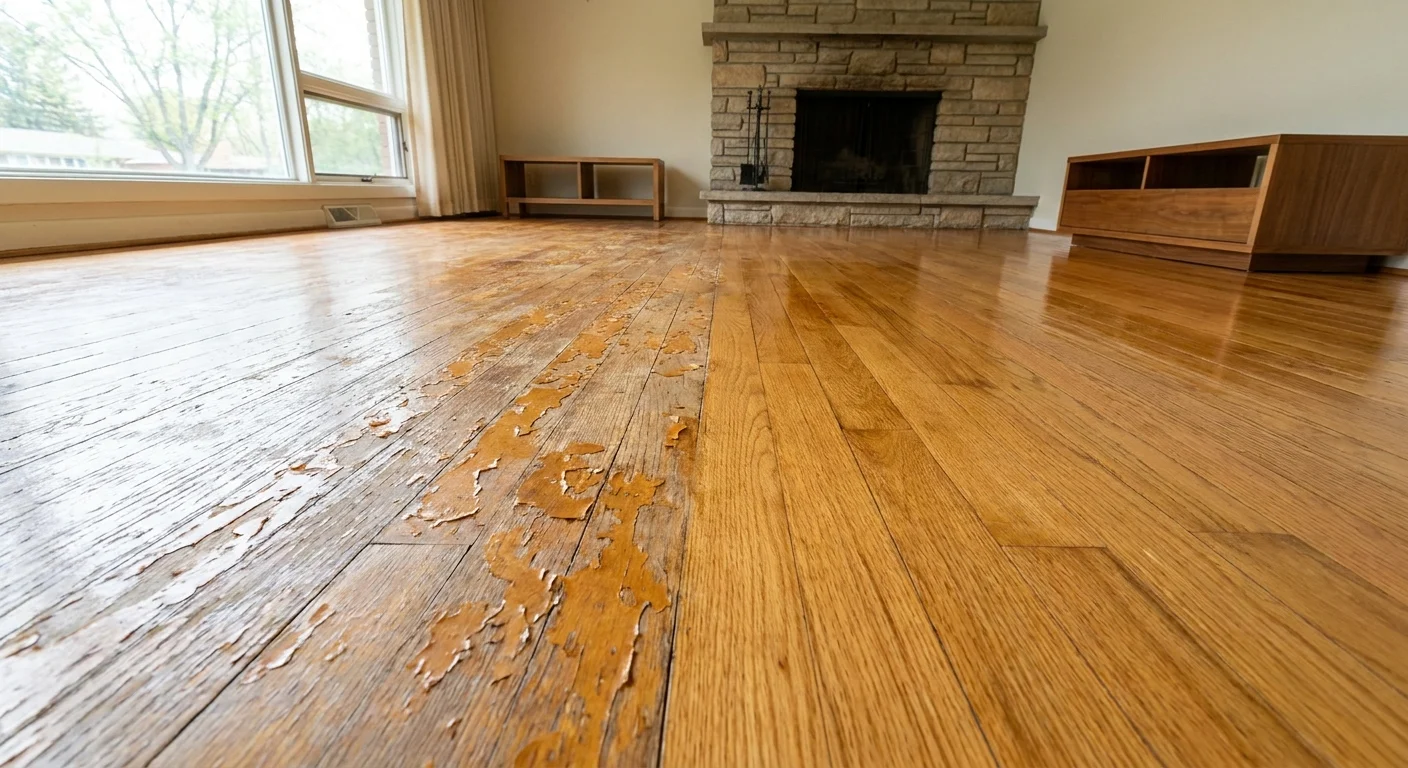
IAC Home Improvement offers professional hardwood floor refinishing services across New Jersey, New York, and Pennsylvania in 2026, helping homeowners restore the beauty and integrity of their floors. Seeing your beautiful hardwood floor finish peeling can be alarming, signaling underlying issues that, if ignored, can lead to more extensive and costly damage. Understanding the causes and appropriate fixes for a peeling finish is crucial for maintaining the longevity and aesthetic appeal of your investment.
This guide will help you identify why your floor finish is flaking, whether it requires a simple recoat or a full sand and refinish, and how to prevent future peeling. We serve homeowners throughout Monmouth County and beyond, including Long Branch, Red Bank, Asbury Park, Middletown, Freehold, Holmdel, Colts Neck, Marlboro, Manalapan, and Eatontown, providing expert solutions for all your hardwood flooring needs.
What Does Peeling Hardwood Floor Finish Look Like?
Peeling hardwood floor finish manifests in several distinct ways, indicating that the protective top layer is failing to adhere properly to the wood or previous coats. Recognizing these signs early is key to addressing the problem before it escalates.
Common Visual Signs of Peeling Finish
The most common indicators of a peeling finish include flaking, bubbling, and delamination, which can appear as dull, chalky, or white patches. You might notice the finish lifting away in small chips or larger sheets, particularly in high-traffic areas, near water sources, or along board edges.
- Flaking: Small, thin pieces of the finish chip away, often resembling dry skin. This is common with polyurethane finishes.
- Bubbling: Air or moisture trapped beneath the finish causes small blisters or bubbles, which eventually burst and lead to peeling.
- Delamination: Larger sections of the finish separate from the wood, creating a visible gap or a "sheet-like" lift. This often occurs when finish layers don't bond to each other or to the wood.
- Chalky or Hazy Patches: The finish loses its clarity and sheen, sometimes turning white or cloudy, indicating moisture penetration or poor adhesion.
Identifying the specific type of peeling can help pinpoint the cause and guide the repair strategy. For instance, peeling around kitchen sinks or entryways often points to moisture, while widespread flaking across an entire room might suggest an application issue.
When to Act: The Cost of Delaying Repairs
Delaying action on a peeling hardwood floor finish can lead to a cascade of problems, significantly increasing repair costs and potentially compromising the structural integrity of your floors. Once the protective finish is compromised, the bare wood becomes vulnerable to moisture, dirt, and wear.
Unprotected wood can quickly absorb spills, leading to dark stains, warping, cupping, or even rot. These deeper issues often necessitate more intensive and expensive repairs than addressing the initial peeling. For example, a timely professional hardwood floor refinishing project typically costs from about $2-$4 per square foot, with projects starting from $1,600, covering sanding, staining (if desired), and multiple coats of new finish. This is a far more economical solution than waiting until the wood itself is damaged.
If the damage is severe and the wood is extensively compromised, a full replacement might be required. Hardwood installation labor for straight-lay solid or engineered wood starts from about $4 per square foot, not including the material cost, with projects typically beginning at $1,300. This makes addressing peeling finish promptly a wise financial decision. Don't let a small problem become a major renovation. If you're seeing signs of peeling, (848) 358-7694 to speak with a flooring expert, text us a photo for an initial assessment, or request a free estimate today.
Why Is My Hardwood Floor Finish Peeling?
Understanding the root cause of peeling finish is essential for implementing the correct repair and preventing recurrence. Several factors, ranging from environmental conditions to application errors, can contribute to this frustrating problem.
Moisture Damage and Humidity Fluctuations
Moisture is one of the most common culprits behind peeling hardwood floor finishes. Hardwood is a hygroscopic material, meaning it readily absorbs and releases moisture from its environment. When wood expands and contracts due to significant changes in humidity, it can stress the finish, causing it to crack and eventually peel.
Common sources of moisture damage include spills that aren't wiped up immediately, pet accidents, leaks from plumbing or appliances, and excessive indoor humidity. High humidity levels, especially above 60% relative humidity, can cause wood to swell, pushing the finish off. Conversely, extremely low humidity (below 30%) can cause the wood to shrink, leading to cracks in the finish. Maintaining a consistent indoor relative humidity between 35-55% is crucial for floor health.
Improper Application or Poor Adhesion
Often, peeling can be traced back to errors during the initial application of the finish. Proper surface preparation and application techniques are paramount for ensuring strong adhesion and a durable finish.
- Inadequate Surface Preparation: If the wood surface was not properly cleaned, sanded, or screened before applying the finish, contaminants like dust, grease, wax, or old cleaning product residues can prevent the new finish from bonding effectively.
- Applying Over Contaminants: Wax-based cleaners or polishes, silicone-based products, or even certain household detergents can leave a residue that acts as a barrier, causing the new finish to "fish-eye" or peel.
- Insufficient Drying Time: Applying subsequent coats of finish before the previous one has fully cured can trap solvents, leading to poor adhesion and bubbling. Each coat typically requires 2-4 hours to dry to the touch, but cure times are much longer.
- Incorrect Application Thickness: Applying finish too thickly or too thinly can affect its ability to cure properly and bond to the surface.
These issues highlight the importance of professional expertise when applying or reapplying hardwood floor finishes, especially in areas like Red Bank and Asbury Park where varied home ages might present different challenges.
Product Incompatibility or Age-Related Issues
Sometimes, the problem stems from the finish product itself or its interaction with previous coatings. Not all finishes are compatible, and using the wrong combination can lead to immediate or delayed peeling.
For example, attempting to apply a water-based polyurethane over an existing oil-based finish without proper preparation or an appropriate bonding agent can result in adhesion failure. Similarly, using an expired finish product or one of poor quality may not provide the expected durability or bond strength. Over time, even a perfectly applied finish will degrade due to UV exposure, foot traffic, and general wear and tear, eventually losing its elasticity and adhesion, leading to natural peeling or flaking after many years.
Can Peeling Engineered Hardwood Be Fixed?
Engineered hardwood floors, while durable, can also suffer from peeling finishes. The good news is that many instances of peeling on engineered hardwood can be successfully repaired, though the approach differs slightly from solid hardwood due to its layered construction.
Assessing the Wear Layer Thickness
The key factor in determining the repair options for peeling engineered hardwood is the thickness of its "wear layer." The wear layer is the top veneer of real hardwood, which is what gets sanded and refinished.
Engineered hardwood wear layers can range from very thin (0.6mm to 2mm) to quite thick (4mm to 6mm or more). Floors with a thin wear layer might only tolerate a light buffing and recoat, as sanding too aggressively would expose the core layers beneath. Floors with a thicker wear layer, comparable to solid hardwood, may be able to withstand one or more full sanding and refinishing cycles, much like traditional solid wood floors. Always consult a professional to accurately assess your wear layer thickness.
Options for Repairing Engineered Hardwood
The repair strategy for engineered hardwood with a peeling finish depends heavily on the extent of the damage and the wear layer thickness. IAC Home Improvement provides expert assessments for homes in Long Branch, Middletown, and surrounding areas.
- Buff and Recoat: If the peeling is minor, localized, and confined to the surface, and the wear layer is thin, a professional can often buff or screen the existing finish and apply a fresh topcoat. This process abrades the surface to improve adhesion without removing significant wood.
- Light Sanding and Refinishing: For engineered floors with a thicker wear layer (typically 2mm or more), a light sanding may be possible. This removes the peeling finish and a minimal amount of wood, allowing for the application of new stain and finish. This is a more involved process than a recoat but less aggressive than a full sand.
- Board Replacement: If a specific area has severe peeling or water damage that has penetrated the wood veneer, individual boards can sometimes be carefully removed and replaced. This requires matching the existing flooring as closely as possible.
- Full Replacement: In cases of widespread, severe peeling, or if the wear layer is too thin for any sanding and the damage is extensive, a full replacement of the engineered flooring might be the most practical and aesthetically pleasing solution.
A professional evaluation is crucial to determine the most effective and cost-efficient repair method for your specific engineered hardwood floor.
Recoat or Refinish: Which Fixes Peeling Hardwood Floors?
When faced with a peeling hardwood floor, homeowners often wonder whether a simple recoat will suffice or if a full sand and refinish is necessary. The choice depends on the nature and extent of the peeling, as well as the underlying causes.
When a Simple Recoat Might Work
A recoat, also known as a screen and recoat, involves lightly abrading the existing finish with a buffer (screen) to create a rough surface, then applying one or two fresh coats of finish. This method is suitable for floors where the peeling is very superficial, localized to the top layer, and the existing finish is still largely intact and well-adhered to the wood.
A recoat is typically effective for addressing minor dullness, light surface scratches, or very early stages of peeling where the finish is only flaking on the surface, and there is no bare wood exposed or deep damage. It rejuvenates the floor's appearance and adds a new layer of protection without the dust and disruption of a full sanding. However, if the peeling extends beyond the surface, a recoat will not solve the underlying adhesion issues and may even peel itself.
When a Full Sand and Refinish is Necessary
A full sand and refinish is the most comprehensive solution for hardwood floors with significant peeling, deep scratches, water damage, or areas where the finish has completely worn away to bare wood. This process involves sanding the floor down to the raw wood using specialized equipment, removing all old finish, stains, and imperfections.
Once sanded, the wood can be stained (if desired) and then sealed with multiple coats of new finish. This method is essential when the peeling is widespread, deep, or caused by severe adhesion failure, product incompatibility, or extensive moisture damage. A full sand and refinish effectively resets the floor, providing a fresh start and a durable new surface. This is the recommended approach for most peeling hardwood floor scenarios, ensuring a lasting repair and a beautiful result.
The Cost and Process of Professional Refinishing
Professional hardwood floor refinishing by IAC Home Improvement typically costs from about $2-$4 per square foot, with most projects starting from $1,600. This all-inclusive price covers the entire process: sanding, stain application (if chosen), and multiple coats of a high-quality finish. The exact cost can vary based on the floor's condition, the type of wood, and the complexity of the project, such as working around intricate inlays or stairs.
The refinishing process usually takes 3-5 days for an average-sized room, depending on the number of coats and drying times. Each coat of finish typically dries to the touch in 2-4 hours, allowing for light foot traffic after 24 hours. However, the finish requires 7-14 days to fully cure and reach its maximum hardness, during which time heavy furniture should be moved with care, and rugs should not be placed on the floor. Our experts ensure a smooth, durable finish that can last for years. Learn more about our hardwood refinishing services at IAC Home Improvement Hardwood Refinishing or find local specialists in your area like Hardwood Floor Refinishing in Long Branch, NJ.
How Can I Prevent Hardwood Floor Finish From Peeling Again?
After investing in a recoat or a full sand and refinish, preventing future peeling is paramount. Proactive maintenance and careful attention to environmental factors are key to preserving your floor's finish and ensuring its longevity.
Proper Cleaning and Maintenance Practices
Consistent and correct cleaning is fundamental to preventing finish degradation. Harsh chemicals, excessive moisture, and abrasive cleaners can all damage the finish over time.
- Use Recommended Cleaners: Always use cleaning products specifically designed for hardwood floors. Avoid multi-surface cleaners, oil soaps, or products containing ammonia, wax, or silicone, as these can leave residues that prevent future recoats from adhering or strip the finish.
- Wipe Spills Immediately: Any liquid spill, especially water, should be wiped up promptly to prevent moisture from penetrating the finish and causing damage.
- Regular Dusting and Vacuuming: Dust, dirt, and grit act as abrasives, scratching the finish and making it more susceptible to peeling. Regularly sweep or vacuum with a soft brush attachment.
- Protect High-Traffic Areas: Use area rugs in entryways, hallways, and under furniture to minimize wear and tear. Place felt pads under furniture legs to prevent scratches.
For more detailed advice on maintaining your floors, visit our guide on Floor Care and Maintenance.
Controlling Environmental Factors
As discussed, humidity and temperature play a significant role in the health of your hardwood floors. Maintaining a stable indoor environment is crucial for preventing expansion and contraction that can stress the finish.
Install a humidifier or dehumidifier to keep indoor relative humidity levels consistent, ideally between 35-55% year-round. Avoid extreme temperature fluctuations. In sunny rooms, use blinds or curtains to protect floors from prolonged direct UV exposure, which can degrade the finish and fade the wood color over time. These precautions are especially important in regions like New Jersey, New York, and Pennsylvania, which experience significant seasonal climate changes.
Choosing the Right Finish and Professional Application
The quality of the finish product and the expertise of its application are critical factors in its durability and resistance to peeling. Investing in high-quality materials and professional application ensures the best possible outcome.
There are various types of finishes, including water-based polyurethane, oil-based polyurethane, and penetrating oils, each with different characteristics regarding durability, appearance, and maintenance. A professional can help you choose the best finish for your lifestyle and floor type. Furthermore, professional application ensures proper surface preparation, correct product mixing, appropriate thickness, and sufficient drying times between coats, all of which are vital for strong adhesion and a long-lasting, peel-resistant finish. IAC Home Improvement is a full-service home improvement company, and we handle the entire project, from flooring to kitchen and bathroom remodeling, painting, carpentry, basements, decks, masonry, concrete, and pavers, providing one trusted contractor for your whole home.
Here's a quick reference table summarizing the signs, causes, and fixes for peeling hardwood finish:
| Sign | Likely Cause | Best Fix |
|---|---|---|
| Small flakes, localized lifting | Minor wear, surface contamination, age | Professional recoat |
| Widespread peeling, bubbles, bare spots | Moisture damage, poor adhesion, incompatible products | Full sand and refinish |
| Peeling around water sources (kitchen, bath) | Water damage, high humidity | Full sand and refinish (assess wood damage) |
| Peeling on engineered wood (thin wear layer) | Wear, surface damage | Buff and recoat, or board replacement |
Frequently Asked Questions About Peeling Hardwood Finish
Can I fix a peeling hardwood floor myself?
While minor, isolated peeling might tempt DIY enthusiasts, addressing peeling hardwood finish effectively often requires professional expertise and specialized equipment. Improper sanding, incorrect product application, or failing to identify the root cause can lead to further damage or a short-lived repair. For a lasting solution, especially for widespread peeling, consulting with professionals like IAC Home Improvement is highly recommended.
How long does hardwood floor finish typically last?
The lifespan of a hardwood floor finish varies significantly based on the type of finish, level of traffic, maintenance, and environmental conditions. Generally, a high-quality professional finish can last anywhere from 10 to 20 years. Oil-based polyurethanes tend to be more durable in high-traffic areas, while water-based finishes offer quicker dry times and less odor. Regular maintenance and humidity control can extend the life of your finish.
Is peeling finish a sign of water damage to the wood itself?
Yes, peeling finish can definitely be an early indicator of water damage to the hardwood itself. When moisture penetrates the finish, it can cause the wood beneath to swell and contract, leading to the finish delaminating. If left unaddressed, this moisture can lead to dark stains, warping, cupping, and even mold growth in the wood. It's crucial to investigate the source of moisture immediately.
What's the difference between a recoat and a refinish for peeling?
A recoat (or screen and recoat) involves lightly abrading the existing finish and applying a new topcoat, suitable for minor surface peeling, dullness, or light scratches where the finish is mostly intact. A full sand and refinish involves sanding the floor down to bare wood, removing all old finish and imperfections, then applying new stain and finish. This is necessary for widespread peeling, deep damage, or when changing the floor's color.
Authoritative resource: National Wood Flooring Association.